
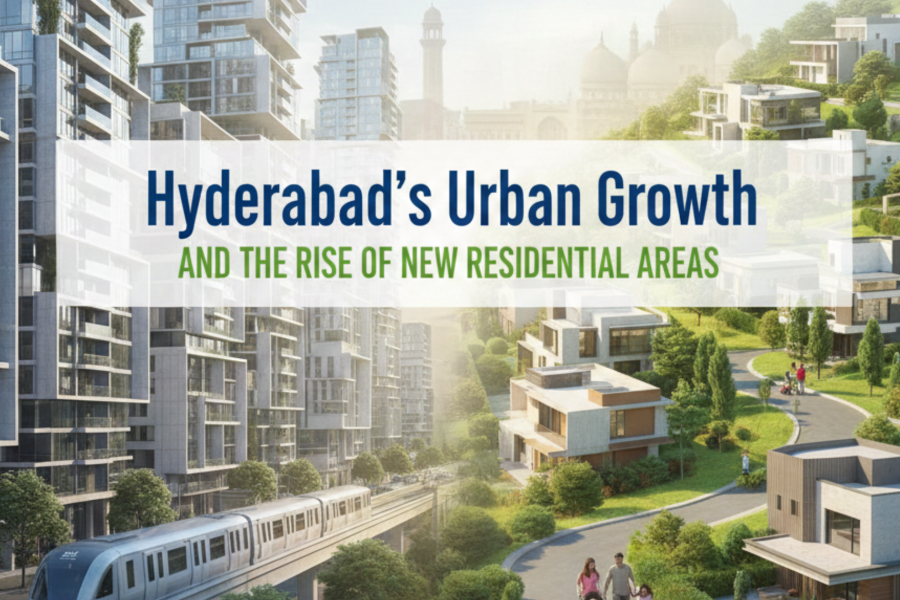
Hyderabad has been expanding for years, but the way it is growing now feels different. Earlier, development was concentrated around a few familiar pockets. Today, the city is stretching outward in multiple directions at the same time, quietly reshaping where people live, work, and invest.
This phase of Hyderabad urban growth is less about landmark projects and more about how everyday residential choices are evolving.
For anyone observing the city closely, one thing is clear: the most meaningful changes are happening outside the traditional city core. New suburbs, peripheral layouts, and planned residential clusters are absorbing demand that central Hyderabad can no longer accommodate. This shift is at the heart of the suburb real estate growth India is currently seeing, with Hyderabad standing out as one of the strongest examples.
What makes this transformation interesting is that it is not driven by speculation alone. It is being supported by infrastructure, employment movement, and lifestyle changes, all of which are influencing property market dynamics in a very real way.
Infrastructure Has Redefined Distance in Hyderabad
A few years ago, distance was a deal-breaker for most homebuyers. Today, that perception has changed completely. Roads, ring roads, and upcoming metro connectivity have made it possible to live farther away from the city centre without feeling disconnected.
The Outer Ring Road played a major role in this shift. Areas that once felt remote are now accessible, practical, and well-linked to employment hubs and the airport. With the Regional Ring Road and metro expansion moving forward, Hyderabad’s urban growth is becoming more structured, not scattered.
This is where emerging residential areas in Hyderabad are beginning to stand out. Connectivity is no longer a future promise; in many locations, it is already shaping demand and pricing. These infrastructure-led changes are also a key reason why the suburb real estate growth India is seeing today is more stable than speculative cycles of the past.
Job Locations Are No Longer Centralized
Another reason Hyderabad is expanding outward is the way employment hubs have spread across the city. IT parks, commercial zones, and business districts are no longer concentrated in a single area. This decentralisation has directly influenced housing demand.
Professionals now prefer to live closer to where they work, even if it means choosing newer residential zones. Locations like Kokapet, Narsingi, Tellapur, Gachibowli, NEopolis, and Rajendra Nagar have gained attention precisely because they sit within or near active employment corridors.
This pattern is changing property market dynamics. Instead of buyers chasing “popular” pin codes, they are looking for practical ones, areas that balance commute time, livability, and future growth. These choices are shaping emerging residential areas that Hyderabad will rely on over the next decade.
Why Buyers Are Moving Away From the City Core
Affordability is an obvious factor, but it is not the only one. Central Hyderabad has become dense, crowded, and expensive. For many buyers, the trade-off no longer makes sense.
Suburban locations offer something central areas cannot: space. Larger homes, gated communities, better amenities, and quieter surroundings are becoming non-negotiable for families and long-term buyers. This lifestyle shift is reinforcing Hyderabad’s urban growth at the edges rather than the centre.
From an investment perspective, suburban real estate growth in India reflects this reality. Capital values may rise faster in well-planned suburbs than in saturated localities. Understanding these property market dynamics helps buyers look beyond short-term appreciation and focus on sustainable value.
Where Hyderabad’s Residential Growth Is Heading
Not every developing area will perform the same way. Growth is selective, and it follows clear patterns.
The western and south-western corridors, including Kokapet, Narsingi, Tellapur, and Tukkuguda, continue to attract premium development due to strong connectivity and proximity to commercial zones. At the same time, other locations such as Rajendra Nagar and Neopolis are gaining relevance for plotted developments and gated communities.
Gachibowli, in particular, illustrates how emerging residential areas Hyderabad nurtures can evolve into mature markets when infrastructure, jobs, and demand align. These examples highlight how
property market dynamics reward patience and informed decision-making.
The Market Is More Complex Than It Appears
One of the biggest misconceptions about Hyderabad’s growth is that every suburb is a good investment. That is simply not true. While suburban real estate growth in India is strong, outcomes vary widely based on planning, execution, and timelines.
Some areas benefit immediately from infrastructure, while others take years to mature. Price movements, rental demand, and livability indicators all differ. This complexity is why many buyers struggle to make confident decisions, especially when navigating the emerging residential areas Hyderabad offers.
Understanding Hyderabad urban growth requires more than looking at price charts. It requires context: how people are moving, where jobs are going, and how infrastructure is actually progressing on the ground.
Looking Ahead
Hyderabad’s expansion is not slowing down. If anything, it is becoming more deliberate. Peripheral and suburban zones are no longer secondary choices; they are becoming the city’s next residential backbone.
For homebuyers, this means better living environments without paying central-city premiums. For investors, it means aligning with long-term suburban real estate growth India is experiencing in planned urban regions.
The key lies in understanding evolving property market dynamics and recognising which emerging residential areas Hyderabad is genuinely building for the future. Those who approach the market with clarity rather than urgency are more likely to benefit from the city’s next phase of growth.
As Hyderabad continues to grow, it is changing the ways in which people select where to live and invest. New residential developments in Hyderabad will provide the foundation for this next stage of development as the area continues to move outward from its traditional boundaries.
These changes present opportunities; at the same time, there are many unknowns regarding property market dynamics that must be addressed to make informed decisions and use resources effectively (time and money)
Anokhi Homes will play an integral role in this space. Anokhi Homes has an extensive understanding of the changing regional markets in Hyderabad, as well as actual, on-the-ground knowledge of how suburbs in India are developing.
Rather than relying on hype and speculation, Anokhi Homes provides buyers and investors with guidance based on a comprehensive understanding of the long-term potential of a particular location, its infrastructure growth, and its potential for appreciation over time.
If you are purchasing your first house or are considering along-term investment, the guidance provided by Anokhi Homes will help you understand how Hyderabad is evolving as a city. When navigating a rapidly changing market, having the right advisory partner will enable you to convert emerging opportunities into timely, confident decisions.